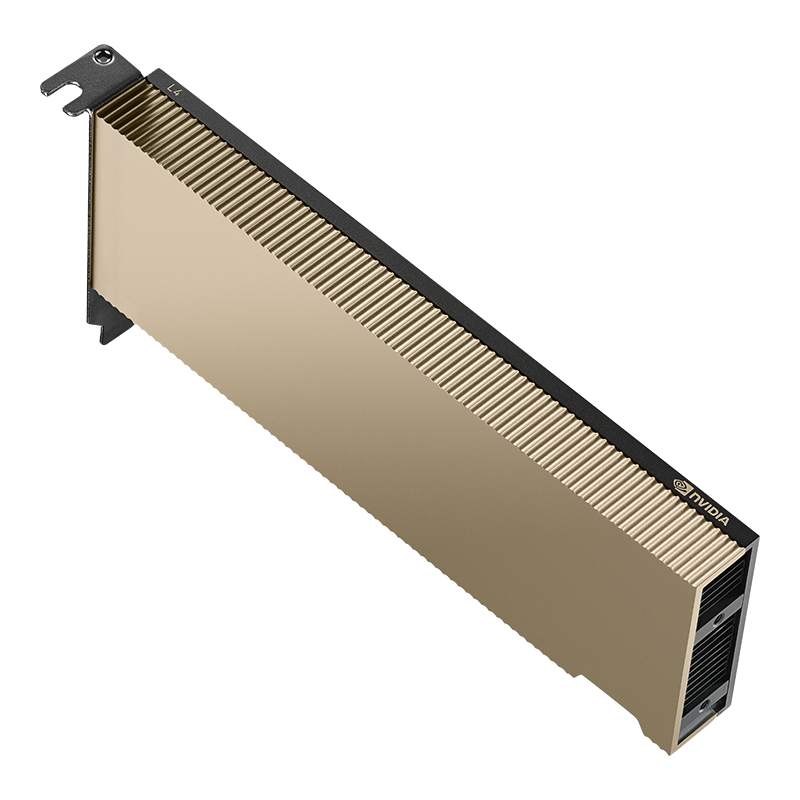
Powered by NVIDIA Ada Lovelace architecture for next-gen performance
4th-gen Tensor Cores with FP8 precision for up to 4x faster AI inference
3rd-gen RT Cores for real-time ray tracing and neural graphics
Supports AV1 encoding/decoding with 4 video decoders and 2 encoders
Handles over 1,000 simultaneous 720p30 video streams per server
24GB GDDR6 memory with 300 GB/s bandwidth
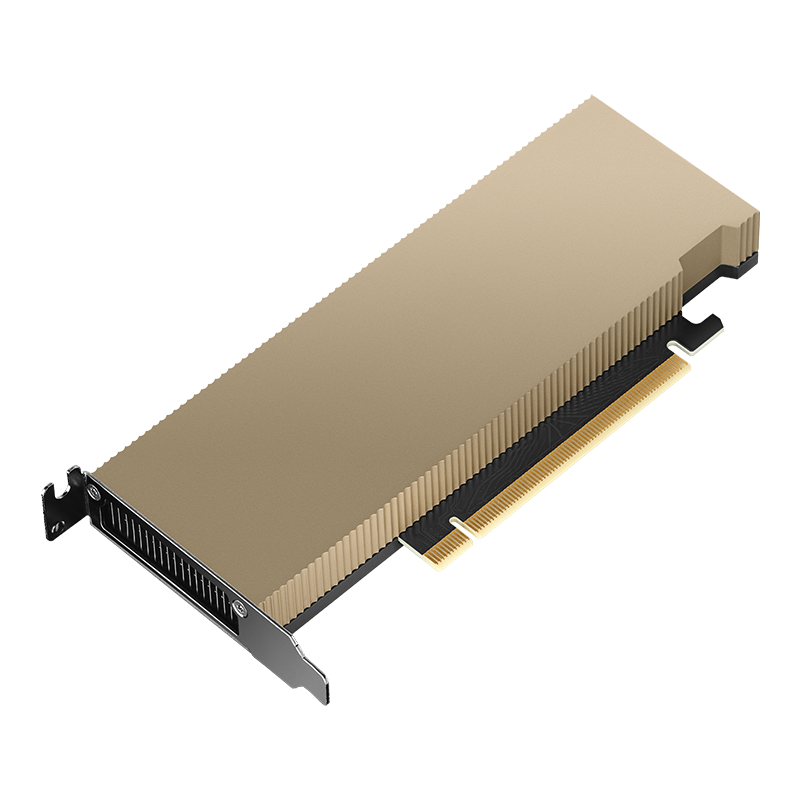
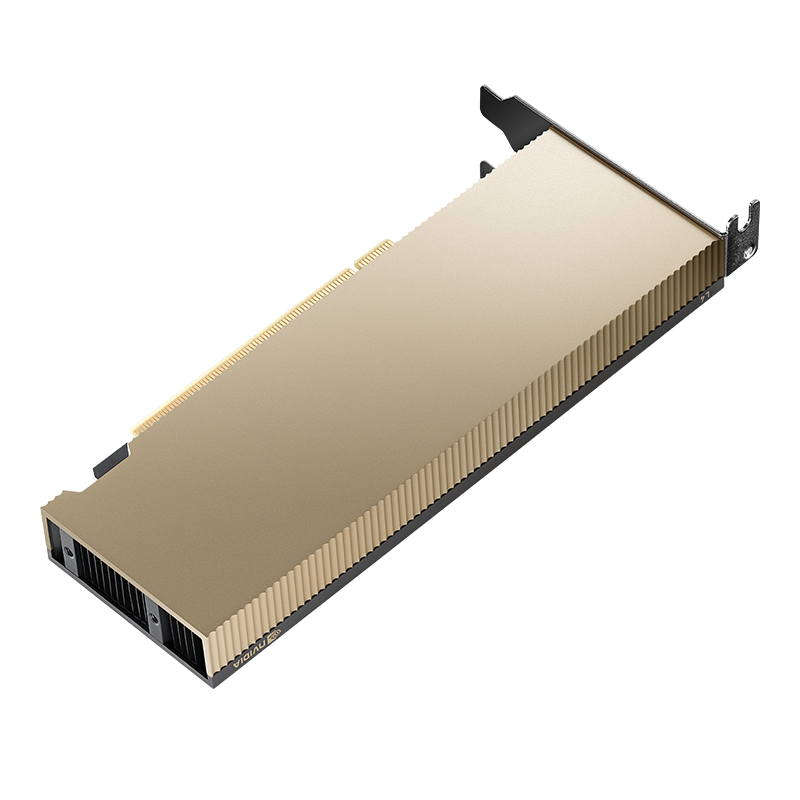
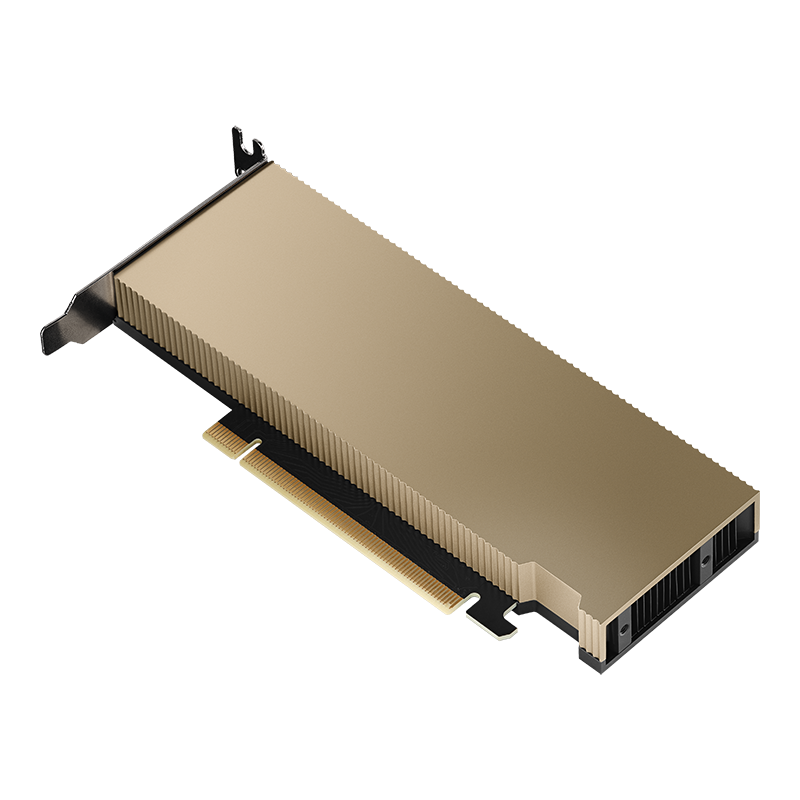
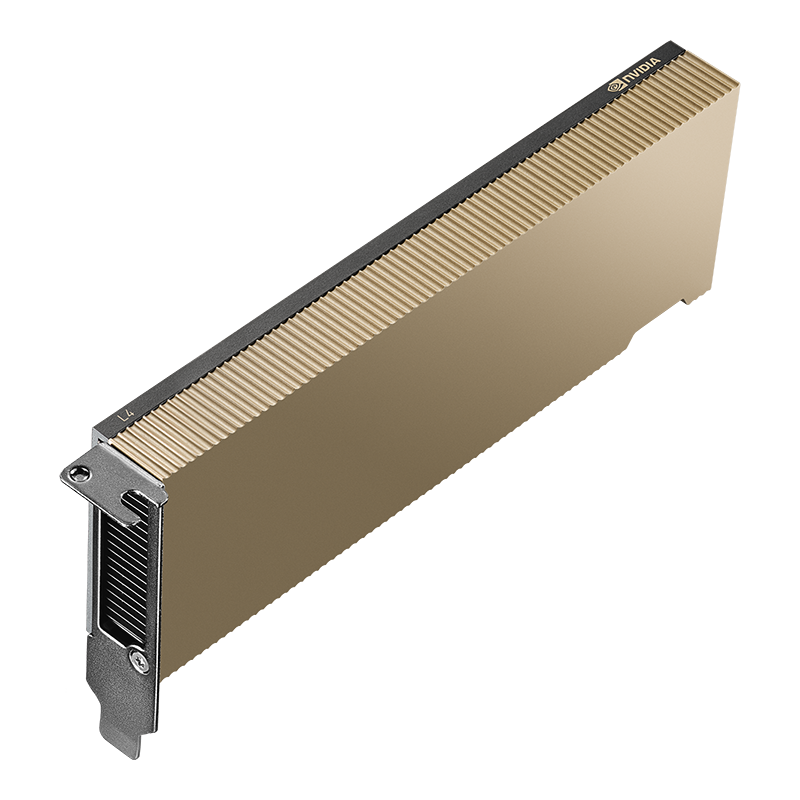
Low-profile, single-slot design – fits standard PCIe Gen4 x16 slots
Consumes only 72W – perfect for dense and energy-conscious deployments
Passive cooling design – silent and efficient operation
Full vGPU support for multi-user virtualization (vPC, vWS, vCS)
Ideal for cloud gaming, AI inference, remote desktops, and edge computing
Certified with NVIDIA’s enterprise and partner ecosystem
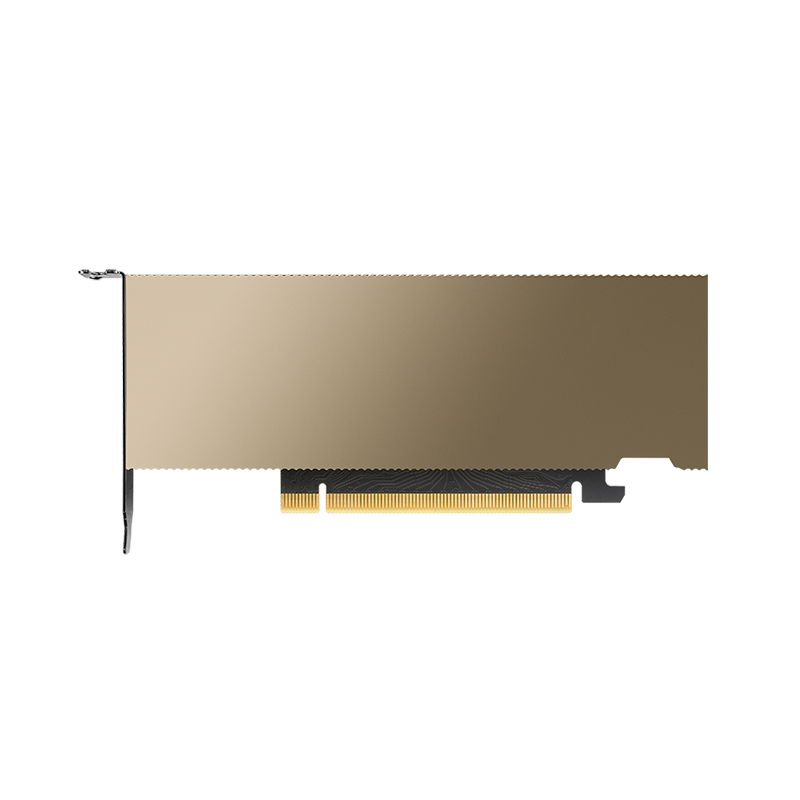
The NVIDIA L4 Tensor Core GPU, built on the groundbreaking Ada Lovelace architecture, is a transformative universal accelerator designed to meet the demanding needs of modern enterprises across the data center, cloud, and edge. As NVIDIA’s most efficient and versatile low-profile GPU, the L4 delivers exceptional performance for a broad spectrum of workloads, including AI inference, video processing, graphics rendering, and virtual workstations—all while maintaining industry-leading energy efficiency.
With its single-slot, low-profile form factor, the NVIDIA L4 is engineered to integrate seamlessly into mainstream PCIe-based servers, making it the ideal solution for organizations looking to introduce or expand GPU acceleration in CPU-based environments. Whether deployed in hyperscale data centers, cloud platforms, or edge computing scenarios, the L4 ensures unmatched scalability, density, and power optimization.
|
|
|
|
|
|
|
|
|
|
|
|
|
|
|
At the heart of the L4 GPU are fourth-generation Tensor Cores, purpose-built for AI workloads. These cores offer support for newer data formats, including FP8, enabling up to 4x faster inference performance compared to the previous generation (such as the NVIDIA T4). This advancement is crucial for modern AI tasks including intelligent virtual assistants, generative models, recommendation systems, and real-time language processing.
The use of FP8 and structured sparsity significantly reduces memory requirements while accelerating computational throughput. Developers and data scientists benefit from faster model training and inference cycles, lower latency, and improved performance across AI pipelines.
NVIDIA pioneered real-time ray tracing with the introduction of RT Cores, and the L4 takes it even further with third-generation RT Cores that double ray-triangle intersection performance. Combined with Shader Execution Reordering (SER), the L4 GPU enables high-performance neural graphics, immersive virtual environments, and realistic lighting simulations with unprecedented speed and realism.
This makes the L4 an ideal choice for applications in cloud gaming, digital content creation, and engineering visualization where quality and responsiveness are paramount.
NVIDIA L4 is optimized for video-intensive applications. It includes four video decoders, two video encoders, and support for AV1 video encoding/decoding, allowing for more than 1,000 simultaneous 720p30 video streams per server. This capability significantly outperforms traditional CPU-based solutions, offering over 120 times more video AI pipeline performance.
Additionally, the inclusion of four dedicated JPEG decoders accelerates vision AI applications, making L4 ideal for smart city surveillance, healthcare imaging, retail analytics, and media processing.
With a TDP of just 72 watts, the L4 delivers performance-per-watt that is unmatched in its class. This makes it an ideal solution for dense server configurations and energy-conscious deployments. Whether you’re deploying in high-density racks or at the network edge, the L4 delivers the performance and efficiency needed to scale your AI, graphics, and video workloads sustainably.
Its passive cooling solution and compact design further reduce infrastructure complexity and cost, while allowing up to eight GPUs per server to be deployed in supported systems.
The NVIDIA L4 is fully compatible with the NVIDIA virtual GPU (vGPU) platform, offering support for:
With vGPU profiles ranging from 1 GB to 24 GB, the L4 enables robust multi-user environments for remote design, engineering, rendering, and data science. Enterprise IT teams can deploy secure, high-performance virtual workstations that offer native-like user experiences from virtually anywhere.
The L4 GPU serves as a universal platform across diverse industries and workloads. Some of its key application domains include:
NVIDIA’s AI platform is the most comprehensive in the industry, combining hardware, software, and ecosystem support to drive AI transformation. The L4 benefits from optimized frameworks, libraries, and tools, including TensorRT, DeepStream, CV-CUDA, and CUDA-X AI, enabling rapid development and deployment of advanced AI models.
It is also supported by NVIDIA’s extensive developer ecosystem, providing documentation, SDKs, sample projects, and cloud-native tools to speed time to deployment.
The L4 is built to meet the reliability and security standards required for enterprise IT infrastructure. From measured boot with hardware root of trust to NVIDIA’s rigorous validation and certification process, the L4 ensures data center-level dependability.
It is also fully tested by NVIDIA and its partners for compatibility with major enterprise applications and platforms, helping IT teams deploy confidently across varied workloads and industries.
The NVIDIA L4 Tensor Core GPU redefines what’s possible with low-profile data center GPUs. With unparalleled versatility, efficiency, and performance across AI, video, graphics, and virtualization workloads, the L4 is positioned as the go-to accelerator for modern data-driven organizations.
Whether you’re powering immersive virtual experiences, accelerating AI pipelines, or deploying edge applications at scale, the L4 delivers the universal performance platform that enterprises need to stay ahead in the age of intelligent computing.
Lorem ipsum dolor sit amet, consectetur adipiscing elit. Ut elit tellus, luctus nec ullamcorper mattis, pulvinar dapibus leo.
The NVIDIA Quantum-X800 platform is the next generation of NVIDIA Quantum InfiniBand, purpose-built for trillion-parameter-scale AI models and comprised of the NVIDIA Quantum-X800 InfiniBand switch, NVIDIA ConnectX®-8 SuperNIC, and LinkX cables and transceivers.
The new platform supports advanced hardware-based, In-Network Computing with Scalable Hierarchical Aggregate Reduction Protocol (SHARP)™ v4, adaptive routing, and telemetry-based congestion control, enabling a new frontier of AI innovation.
The NVIDIA Quantum-X800 InfiniBand switch provides 144 ports of 800Gb/s connectivity per port. It includes hardware-based In-Network Computing with SHARP v4, adaptive routing, telemetry-based congestion control, performance isolation capabilities, and a dedicated port supporting the Unified Fabric Manager (UFM). NVIDIA Quantum-X800 switches also add advanced power-efficiency features, including low-power link state and power profiling.
The NVIDIA Quantum-X800 switch provides increased performance and power efficiency to significantly reduce scientific computing, AI workload completion time, and energy costs.
Quantum-X silicon photonics switches further reduce total power consumption and latency by minimizing the distance and number of connections between optics and electronics.
The NVIDIA ConnectX-8 SuperNIC delivers 800Gb/s connectivity with ultra-low latency and supports the latest in advanced In-Network Computing. Based on the ConnectX architecture, it continues to provide accelerated MPI hardware engines, quality of service, adaptive routing, congestion control, and more.
The NVIDIA Quantum-X800 platform connectivity options with the NVIDIA LinkX® interconnect portfolio provide the maximum flexibility for building a preferred network topology, using connectorized transceivers with passive fiber cables and linear active copper cables (LACCs).
Your email address will not be published. Required fields are marked *