
Compatible with high core-count processors including Genoa, Genoa-X, and Bergamo
Massive 6TB DDR5 memory capacity across 24 DIMM slots for memory-intensive workloads
12x PCIe Gen 5.0 x16 slots supporting up to 10 double-width GPUs
Dual-root architecture for optimized GPU-to-CPU and GPU-to-GPU communication
24x 2.5” hot-swappable drive bays for flexible storage with support for NVMe and SATA
8x NVMe ports directly via SoC for ultra-fast storage access
2x 10GBASE-T Ethernet ports for high-speed networking
IPMI with ASPEED AST2600 BMC for full remote server management
4x 2000W redundant power supplies (2+2) with 80 PLUS Titanium efficiency
4U rack-mountable design, built for high-density GPU deployment
Ideal for AI training, HPC, deep learning, and large-scale data analytics
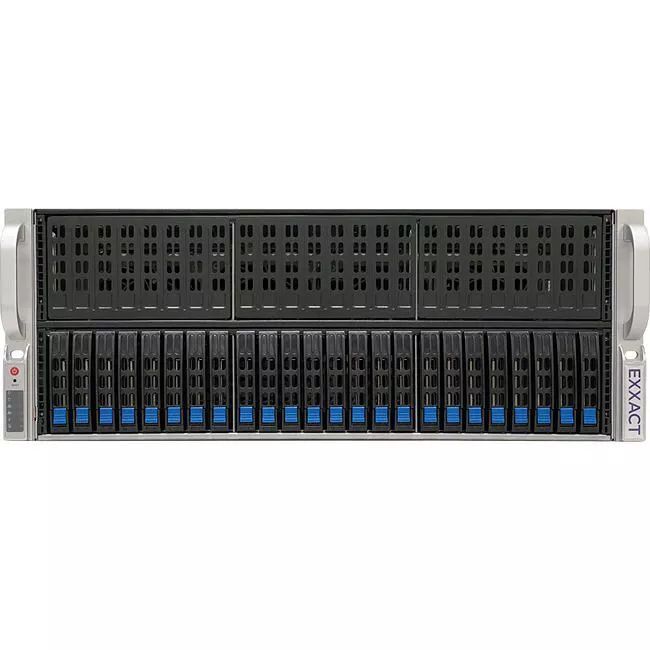
The Exxact TS4-192736136 server is built for high-performance computing, AI workloads, and enterprise-level data processing. At the heart of this server lies support for up to two AMD EPYC 9004-Series processors, including the Genoa, Genoa-X, and Bergamo families.
These processors offer exceptional core density, performance-per-watt efficiency, and advanced memory handling—ideal for demanding computational environments.
The server utilizes the SP5 socket (LGA-6096), specifically designed for AMD’s 4th generation EPYC processors.
This socket accommodates CPUs with a thermal design power (TDP) of up to 400W, ensuring support for the highest-performance models, including the 96-core EPYC 9654 and the 128-core Bergamo 9754.
With dual-processor capability, the TS4 can scale to extreme levels of compute power, perfect for AI model training, simulation, and virtualization tasks.
Unlike traditional server architectures, the TS4 features a System-on-Chip (SoC) design. This approach consolidates I/O, memory, and processing onto a single silicon package, reducing latency and increasing throughput.
Since there is no separate chipset involved, the EPYC processor handles all the duties typically associated with a chipset—simplifying the motherboard layout and boosting overall system efficiency.
This advanced architecture allows full exploitation of the EPYC platform’s robust PCIe Gen 5.0 lanes, DDR5 memory channels, and high-bandwidth fabric.
With support for more than 400W per socket, liquid or enhanced air cooling options may be recommended depending on workload.
Whether you’re running deep learning frameworks, rendering farms, or mission-critical databases, the TS4’s dual-socket EPYC configuration offers unparalleled scalability, reliability, and compute density in a 4U form factor.
The Exxact TS4 supports up to an impressive 6TB of DDR5 SDRAM, operating at DDR5-4800 speeds (PC5-38400). With 24 DIMM slots, the system ensures maximum scalability for memory-intensive applications such as real-time analytics, virtualization, or AI model training.
DDR5 technology provides substantial performance advantages over DDR4, including increased bandwidth, lower power consumption, and improved error correction.
This allows for faster data access and more reliable performance, particularly in parallel processing environments.
The memory subsystem is fully optimized for the AMD EPYC architecture, offering eight memory channels per processor for a total of 16 when two CPUs are installed.
This enables extremely high memory bandwidth, which is crucial for workloads like large in-memory databases and machine learning pipelines.
With support for RDIMM or 3DS RDIMM, this platform provides both scalability and reliability.
ECC (Error-Correcting Code) further enhances system stability by automatically correcting data corruption in real-time, making the TS4 ideal for enterprise data centers and scientific computing.
The Exxact TS4 includes integrated display functionality powered by the ASPEED AST2600 BMC (Baseboard Management Controller).
This graphics controller is not intended for GPU acceleration but rather for server management and remote console access.
The AST2600 provides VGA output, enabling local video access during setup or troubleshooting. More importantly, it supports IPMI 2.0 for full out-of-band management.
System administrators can monitor, control, and update the server remotely—even when the OS is unresponsive—via a dedicated IPMI LAN port.
This onboard video is crucial for headless server environments, where direct access to a GUI or terminal is occasionally required. It enables BIOS configuration, system health monitoring, and hardware troubleshooting from a remote console.
The AST2600 ensures reliable server management and is standard across enterprise-grade servers. While not a performance GPU, it serves its purpose well in providing robust, secure, and responsive remote management for administrators.
The Exxact TS4 provides 24x 2.5” hot-swap drive bays, allowing for flexible storage configurations. These drive bays can accommodate SATA or NVMe SSDs, making it possible to optimize for either high capacity or high-speed storage.
Hot-swappable functionality means drives can be replaced or upgraded without powering down the server—a key feature for minimizing downtime in enterprise environments. The tool-less design improves serviceability and speeds up maintenance.
The integration of 8 NVMe interfaces via the SoC ensures ultra-fast storage access, essential for high IOPS workloads such as real-time analytics, AI training, and virtualization. NVMe storage provides lower latency and higher throughput compared to traditional SATA SSDs.
This design enables hybrid storage environments with tiered storage strategies, where frequently accessed data resides on NVMe, and bulk data is stored on SATA. Whether used as a high-speed data cache or primary storage, the TS4’s storage flexibility is a core advantage.
Designed for high-end compute and GPU workloads, the TS4 boasts an extraordinary 12x PCIe Gen 5.0 x16 slots. These slots support up to 10 double-wide GPU accelerators, allowing for massive parallel compute density in a single 4U chassis.
PCIe Gen 5.0 offers double the bandwidth of Gen 4.0—up to 64 GB/s per slot—making it ideal for high-throughput devices such as NVIDIA H100, A100, or other accelerator cards. This bandwidth ensures GPUs can access system memory and storage with minimal bottlenecks.
The dual-root configuration divides the PCIe lanes between two CPUs, enabling balanced bandwidth and reducing latency for GPU-to-GPU communication. This architecture is ideal for large-scale AI model training, data science workloads, or rendering tasks.
In addition to GPU slots, PCIe expansion allows for network cards, NVMe storage adapters, or FPGA add-ons, making the system flexible and future-proof. The sheer number of high-speed slots positions the TS4 among the most capable GPU servers available.
The server supports a range of AMD EPYC processors, including:
Memory configurations can be customized with 24 DIMM slots, supporting up to 6TB of DDR5 ECC Registered memory. Available module sizes include 16GB, 32GB, 48GB, 64GB, 96GB, and 128GB, all operating at 4800MT/s.
The server supports a variety of NVIDIA GPUs, including:
Lorem ipsum dolor sit amet, consectetur adipiscing elit. Ut elit tellus, luctus nec ullamcorper mattis, pulvinar dapibus leo.
The NVIDIA Quantum-X800 platform is the next generation of NVIDIA Quantum InfiniBand, purpose-built for trillion-parameter-scale AI models and comprised of the NVIDIA Quantum-X800 InfiniBand switch, NVIDIA ConnectX®-8 SuperNIC, and LinkX cables and transceivers.
The new platform supports advanced hardware-based, In-Network Computing with Scalable Hierarchical Aggregate Reduction Protocol (SHARP)™ v4, adaptive routing, and telemetry-based congestion control, enabling a new frontier of AI innovation.
The NVIDIA Quantum-X800 InfiniBand switch provides 144 ports of 800Gb/s connectivity per port. It includes hardware-based In-Network Computing with SHARP v4, adaptive routing, telemetry-based congestion control, performance isolation capabilities, and a dedicated port supporting the Unified Fabric Manager (UFM). NVIDIA Quantum-X800 switches also add advanced power-efficiency features, including low-power link state and power profiling.
The NVIDIA Quantum-X800 switch provides increased performance and power efficiency to significantly reduce scientific computing, AI workload completion time, and energy costs.
Quantum-X silicon photonics switches further reduce total power consumption and latency by minimizing the distance and number of connections between optics and electronics.
The NVIDIA ConnectX-8 SuperNIC delivers 800Gb/s connectivity with ultra-low latency and supports the latest in advanced In-Network Computing. Based on the ConnectX architecture, it continues to provide accelerated MPI hardware engines, quality of service, adaptive routing, congestion control, and more.
The NVIDIA Quantum-X800 platform connectivity options with the NVIDIA LinkX® interconnect portfolio provide the maximum flexibility for building a preferred network topology, using connectorized transceivers with passive fiber cables and linear active copper cables (LACCs).
Your email address will not be published. Required fields are marked *